
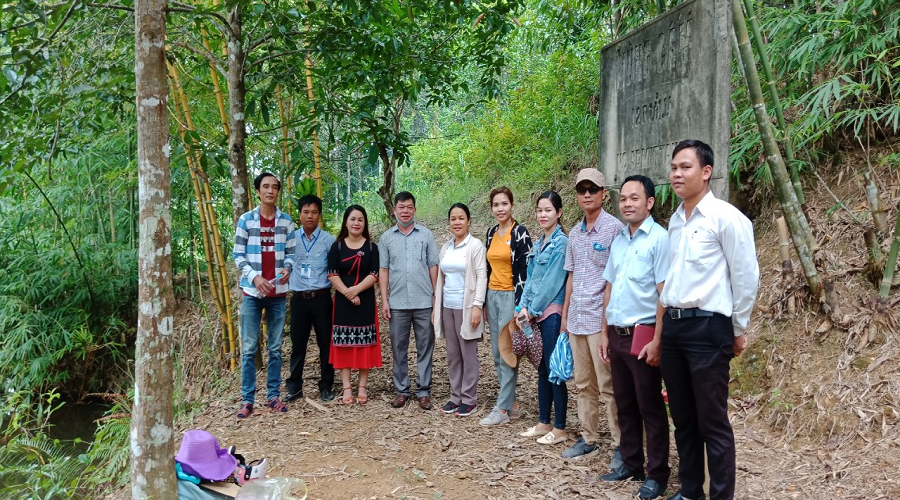
The A Don Tunnel Historical Site
The A Don Tunnel historical site, located on A Don Hill in Can Nong village, Quang Nham commune, A Luoi district, Thua Thien Hue province, is not only a unique military structure but also a place that preserves the heroic history of the Vietnamese people during the resistance war against the United States.
Getting to the A Don Tunnel
To reach the A Don Tunnel, visitors can start from the center of A Luoi town, travel westward along QL49B road to Quang Nham commune. From there, follow the directions from the locals to find the path leading up to A Don Hill, where the historical tunnel is located.
History and Importance of the A Don Tunnel
In January 1968, as Hanoi was preparing to celebrate the Tet Offensive, a group of officials, reporters, editors, and technical workers from the Voice of Vietnam were urgently assigned to the southern battlefield to establish the Liberation Radio Station in Hue. This station was to support the General Offensive and Uprising of the military and people of Tri Thien Hue. The team of 16 people was led by Comrade Nguyen Kim Cuc, with Comrade Nguyen Thanh, Deputy General Director of the Voice of Vietnam, directly commanding.
After 20 days and nights of traversing forests and streams, the team reached A So valley in A Luoi district, western Thua Thien Hue. However, due to the intense combat situation, the Liberation Radio Station in Hue could not move to the lowlands and had to remain in the western base of Thua Thien Hue. The team moved to the Pa Dung mountainous area near the To Rinh River to establish their operational base. The 559th Transport Battalion sent an engineering platoon to help dig a tunnel through the mountain, and the Civil Administration Party Committee of western Thua Thien Hue provided a militia platoon to protect and support logistics.
Structure of the A Don Tunnel
The A Don Tunnel is divided into two main areas:
Area I: Consists of a tunnel with two interconnected entrances. Entrance 1 faces east, with a height of 1.5 meters, a width of 1.5 meters, and a length of 10 meters. Entrance 2 is about 10.8 meters south of Entrance 1. This area served as the living and dining quarters for the technical staff and editors of the station.
Area II: Consists of a tunnel with two interconnected entrances and extends into the mountain in a Y-shape. Entrance 1 is oriented west, with a height of 2.5 meters, a width of 2 meters, and a length of 6 meters. Entrance 2 is about 12.5 meters northeast of Entrance 1, with a height of 2.5 meters, a width of 2 meters, and a length of 20 meters. The Y-shaped layout of the tunnel was used for daily operations and housed the technical equipment and broadcast systems of the Liberation Radio Station in Hue.
Operations and Significance of the Liberation Radio Station in Hue
Once the base was established, the Liberation Radio Station in Hue installed a transmitter and communicated with the Southern Liberation Radio Station in Hanoi using a 15-watt VTD transmitter. Although it existed for a short period, the station played a crucial role in broadcasting the voice of the Party and the people, boosting the morale of the officers, soldiers, and people of Tri Thien Hue during the fierce enemy counterattacks.
Historical Significance of the A Don Tunnel
The A Don Tunnel historical site – headquarters of the Liberation Radio Station in Hue, signifies the great victory of our military and people during the Tet Offensive of 1968 in the southern battlefield, especially in Tri Thien Hue. The tunnel is a powerful testament to the intelligence and creativity of our military and people in overcoming hardships, ensuring necessary communication for the battlefield, and promptly encouraging the fighting spirit.
The A Don Tunnel historical site – headquarters of the Liberation Radio Station in Hue was recognized as a provincial-level historical site on October 13, 2006. Today, the tunnel serves not only as a place for educating about patriotic traditions but also as a source of pride for the contributions of the people of Quang Nham commune, A Luoi district, in the resistance war against the United States.

